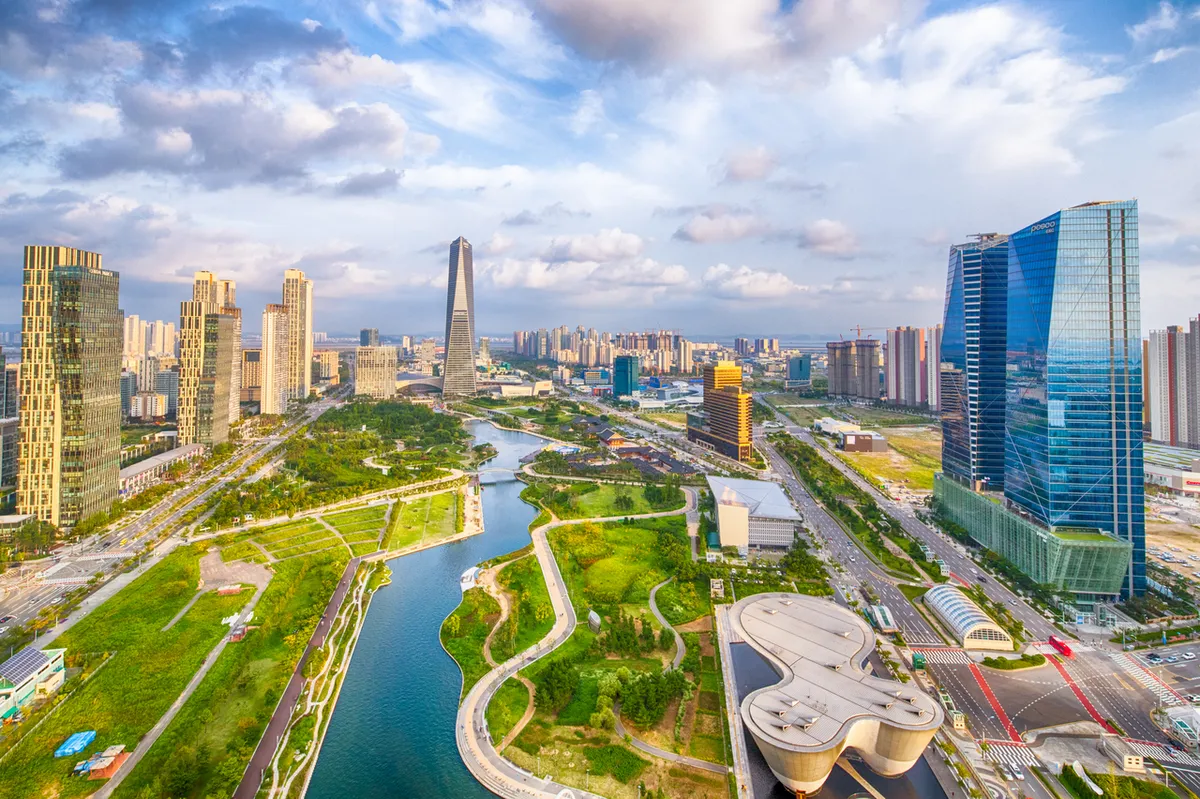
Songdo Central Park (송도 센트럴파크) places a managed seawater channel, landscaped gardens and public art among the high-rise buildings of Incheon's Songdo International City. Created as part of the district's development in the late 2000s, it presents the city's architecture from public waterfront paths rather than from inside its towers.
This guide focuses on the park's walking spaces, contrasting landscapes and the nearby Tri-Bowl cultural venue. General park admission is free; building interiors, separately operated facilities and temporary programs have their own access conditions.
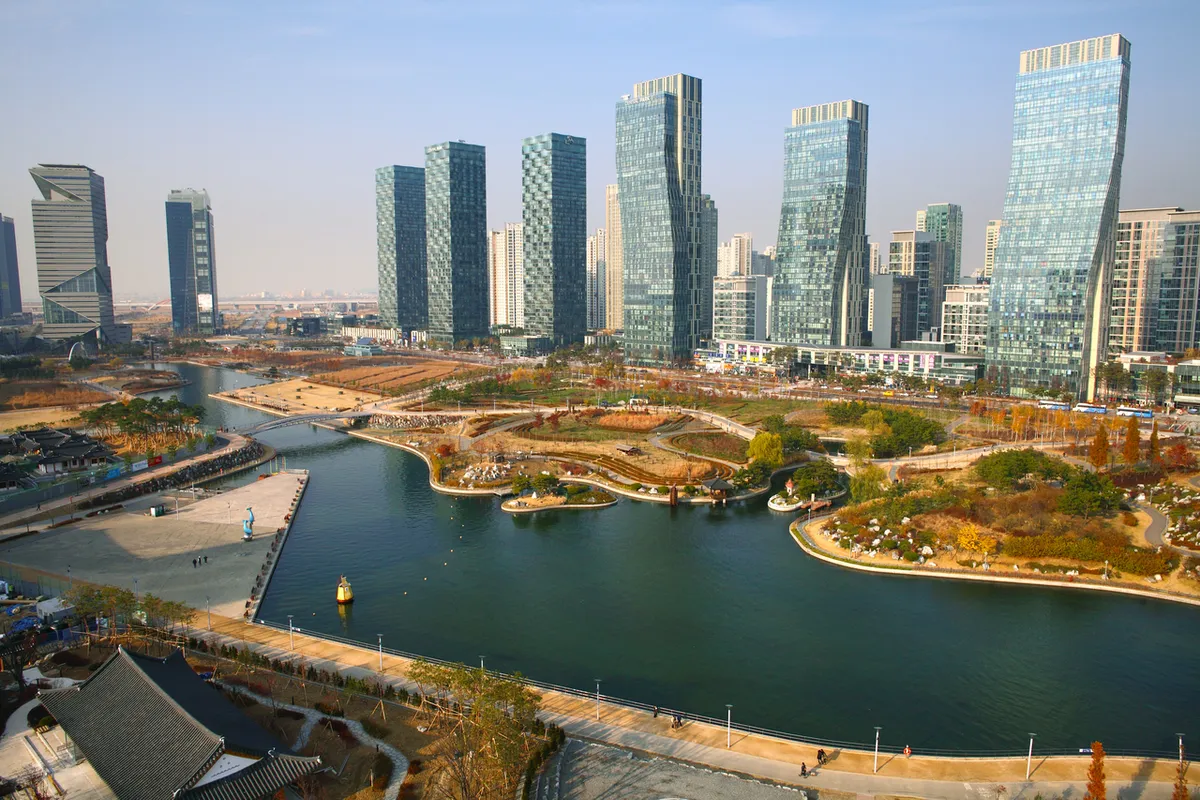
Photo: Korea Tourism Organization / MMP Kim Jin-gyu (김진규), November 2014.
1. Songdo Central Park and its seawater landscape
The waterway is central to the park's design, not simply a decorative pond beside the buildings. Water from the West Sea passes through a three-stage filtration system before entering the park and subsequently returning to the sea. This is a deliberately managed seawater landscape, rather than a natural river or freshwater lake.
The channel extends for 1.8 kilometres and changes width along its course. That measurement describes the waterway, not a signed walking circuit or the distance needed to visit every garden. Choose the sections and public spaces that interest you without treating the channel's length as a complete itinerary.
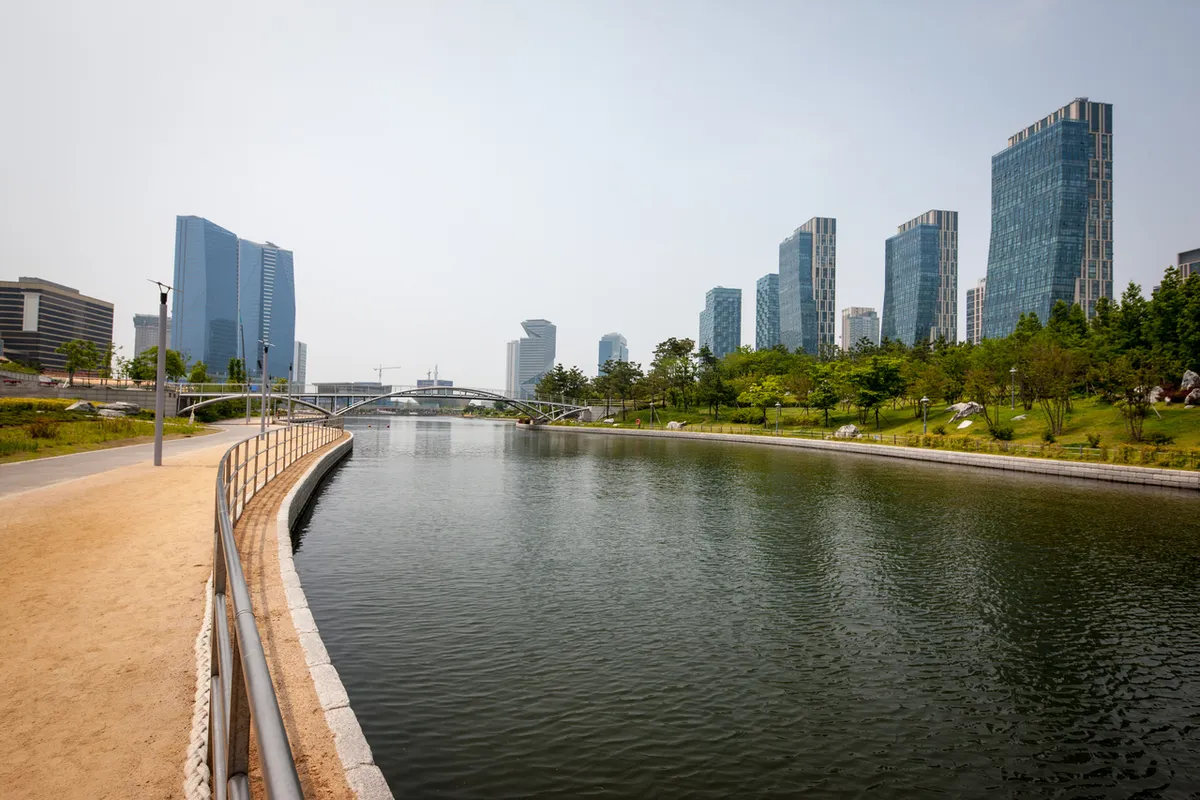
Photo: Korea Tourism Organization / Kim Ji-ho (김지호), June 2014.
The design draws on Korean geographical characteristics, combining water with planted terrain and areas at different levels. Seen from the paths, the open water creates a foreground to the surrounding towers. The contrast is part of the visit: lawns, planted banks and sculpture sit beneath buildings that otherwise dominate the skyline.
The park is not a viewing-deck ticket bundled with access to nearby skyscrapers. Towers can be appreciated from public ground, while office buildings, hotels and other privately operated interiors remain separate destinations. No tower interior is required to understand the relationship between the park and the city around it.
TripKorea's Tip: Use the waterway as a visual reference, not a promised loop route. Paths, landscaped spaces and nearby buildings have different access conditions, and on-site barriers take priority over an older map or photograph.
2. Gardens, waterfront paths and public art
The named gardens give the park more variety than a single waterside promenade. Sunset Garden (선셋정원), at the western end, includes a waterfront stage, children's garden and cube sculpture. The presence of a stage identifies a designed public space; it does not mean a performance will be taking place during your visit.
Elsewhere, the garden called Gamseong Garden (감성정원) combines an observation deck with the artwork 지구촌의 얼굴, meaning “Faces of the Global Village.” The work uses masks symbolising 120 countries. Its international theme belongs to the park's public-art setting, rather than to a separate gallery requiring an indoor visit.
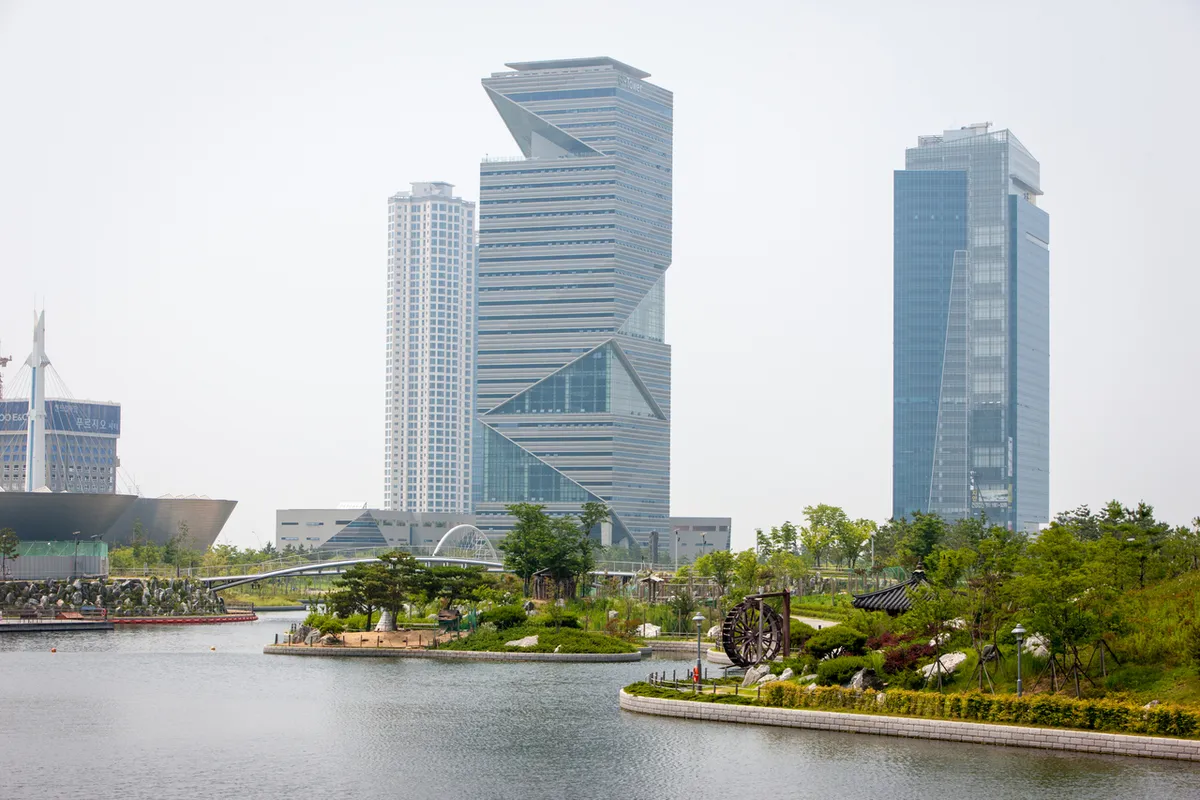
Photo: Korea Tourism Organization / Kim Ji-ho (김지호), June 2014.
Chojiwon (초지원) brings together lawn, a wetland garden, an observation deck and public artworks. These smaller landscape features provide different foregrounds to the same urban skyline. They are useful subjects to look for alongside the larger channel views, without turning the visit into a checklist of every sculpture.
The Walking Garden (산책정원) is a traditional-themed landscape. Songhwajeong Pavilion (송화정) stands on higher ground to its east, adding a tiled-roof architectural form to the park setting. Treat the pavilion as a landscape feature to view; its presence does not establish unrestricted access to its interior.
Terrace Garden (테라스정원) includes UN Plaza and a traditional-play area. Together with the other gardens, it shows how the park combines open gathering spaces with more closely planted walking areas. An event space or play-area name does not guarantee an organised activity on a particular date.
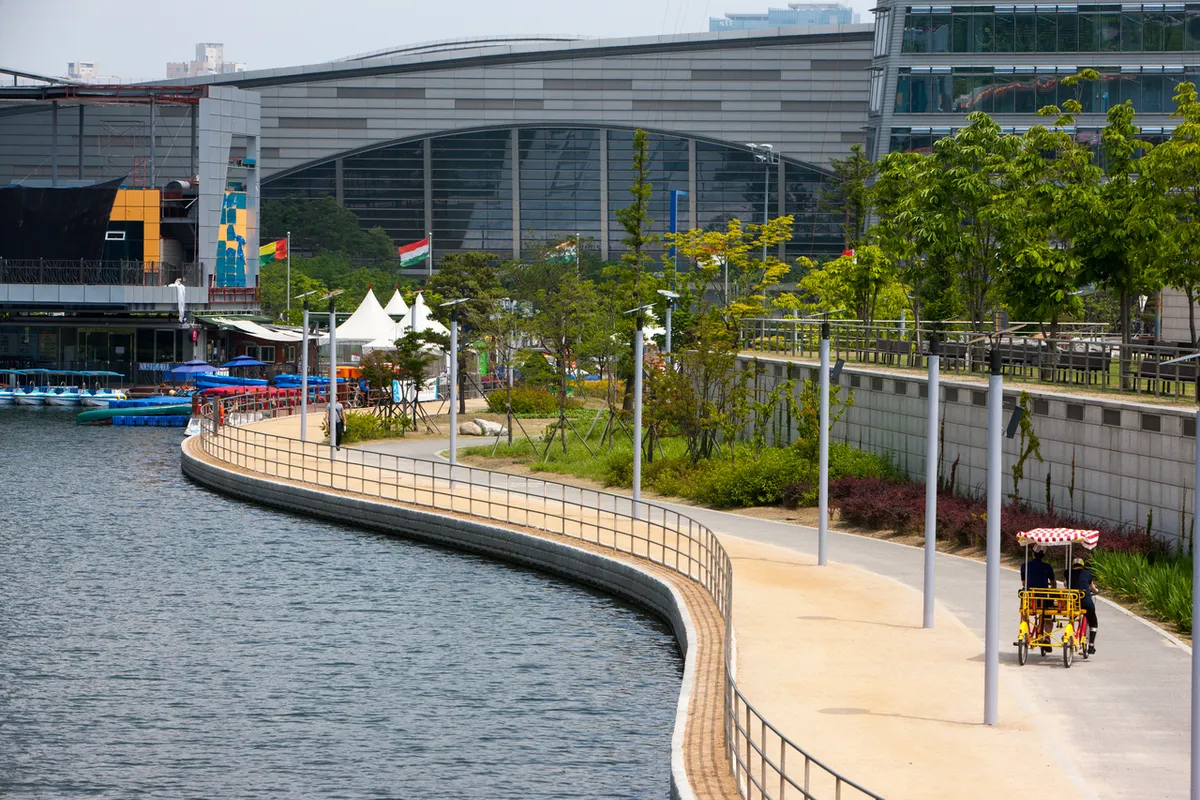
Photo: Korea Tourism Organization / Kim Ji-ho (김지호), June 2014.
TripKorea's Tip: The photographs show the landscape in different seasons and past years. Autumn foliage, clear water reflections and the presence of people or bicycles in an archival scene do not establish current conditions, access permissions or facility operation.
3. Tri-Bowl and the contrast of architectural forms
Tri-Bowl (트라이보울) is a cultural-arts venue whose three bowl-shaped forms stand over a rectangular water feature. Built as a major facility for the 2009 Incheon World City Festival, it uses an inverted-shell structure rather than the familiar arrangement of straight walls rising from a flat building footprint.
The three forms refer symbolically to sky, ocean and earth. Curved surfaces and the relationship between the building and the water give it a different character from the vertical towers behind the park. It appears to hover over the water, but it is not a floating or movable structure.
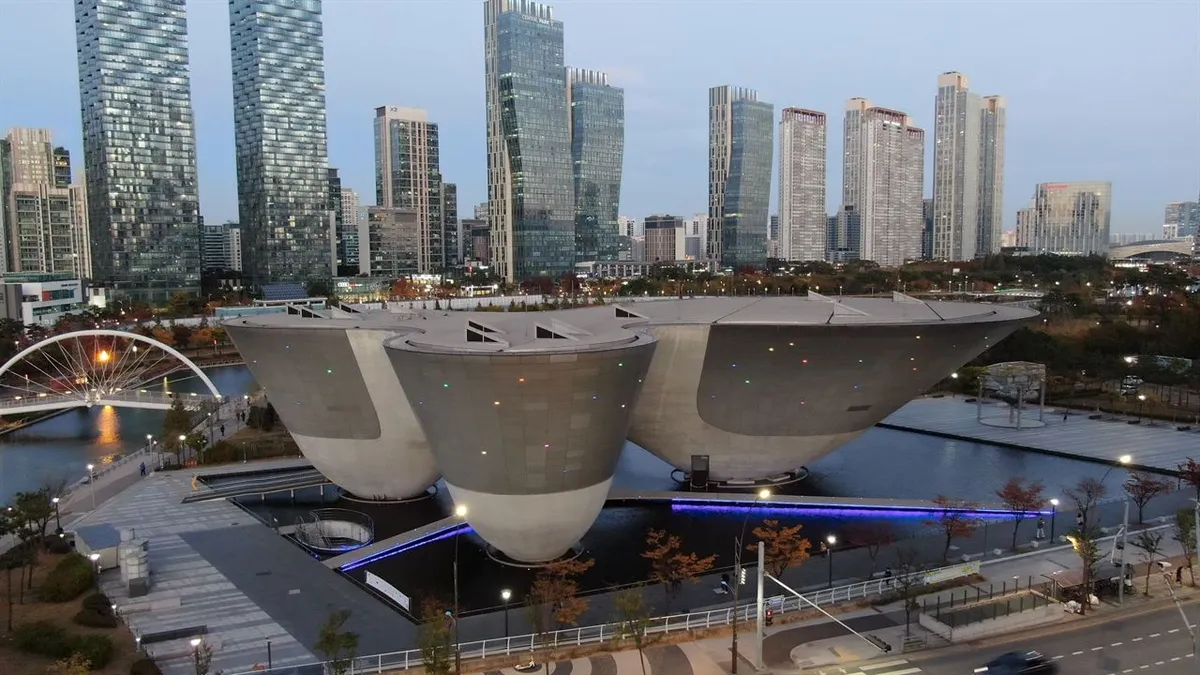
Photo: Korea Tourism Organization / Live Studio (라이브스튜디오), October 2020.
Architectural viewing from the surrounding public landscape is distinct from entering the venue. A bridge and approach spaces belong to the building's setting, but their appearance in a photograph does not guarantee unrestricted access during events, maintenance or setup. Follow the signs and access arrangements in place.
Indoor visits depend on the actual program; there is no permanent exhibition to assume is always available. A temporary exhibition runs from October 13 through December 13, 2026, with viewing 12:00–17:30, last entry 17:10, and Monday closure. The last Wednesday of each month has extended hours until 19:30, last entry 19:10. These are exhibition conditions, not the opening hours of the park.
For architectural contrast at a smaller scale, the traditional-style buildings of Songdo Hanok Village can be viewed in the waterfront setting. They should not be described as an intact historical residential village. Public park paths and the interiors or courtyards of commercial properties have different access rights.
TripKorea's Tip: Keep the outdoor visit independent of an indoor exhibition. If you want to enter Tri-Bowl, check the dated listing for your visit rather than relying on office hours or an old event page.
4. Getting there and planning a ground-level visit
Use Central Park Station (센트럴파크역) on Incheon Subway Line 1. Exit 3 is listed for Central Park, Tri-Bowl and Songdo Hanok Village. The station has elevators between the platform and concourse, plus an elevator between the concourse and street at Exit 3.
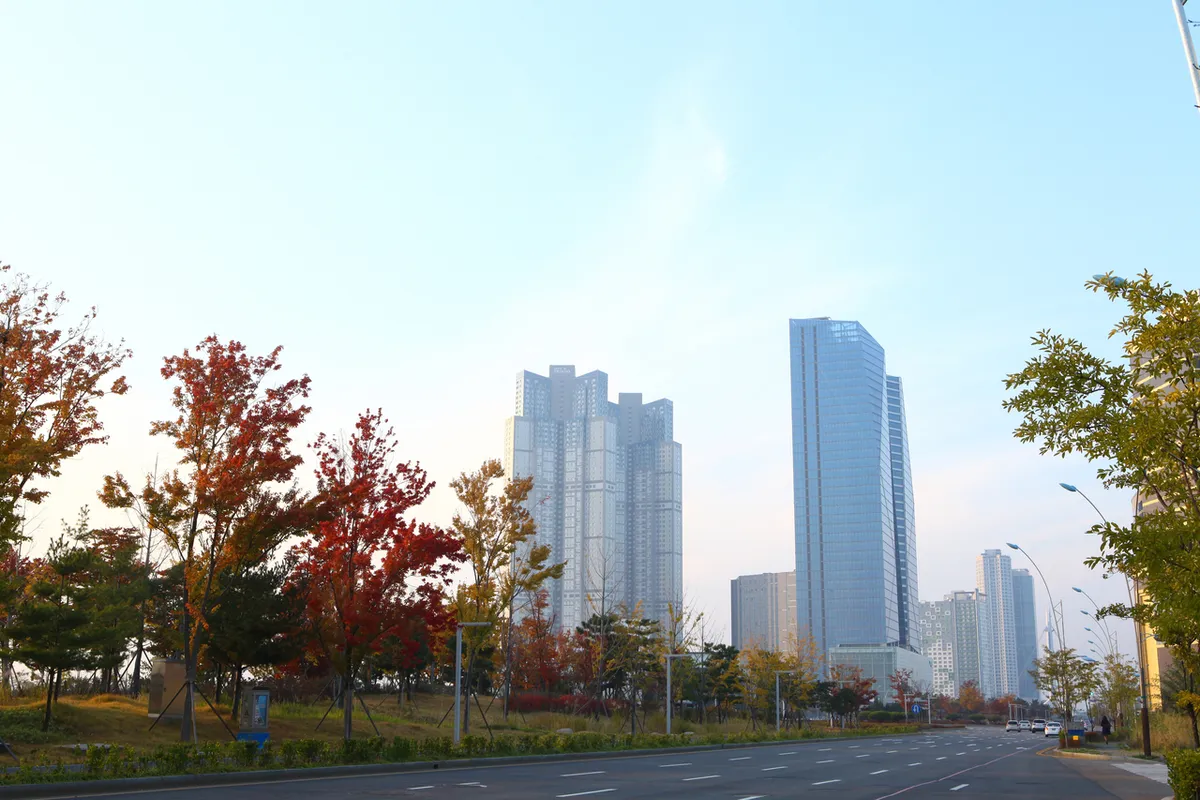
Photo: Korea Tourism Organization / Lee Beom-su (이범수), November 2015.
The park's visitor address is 160 Convensia-daero, Yeonsu-gu, Incheon. For park enquiries, call 032-456-2860. Tri-Bowl is separately addressed at 250 Incheon tower-daero, Yeonsu-gu, with enquiries at 032-832-7996. Use the contact appropriate to the place you intend to enter.
The grounds are open year-round and general admission is free. Do not extend that statement to parking, rentals, buildings or every cultural event. Park access and facility schedules are separate, and toilets inside buildings should not be assumed to remain available all night.
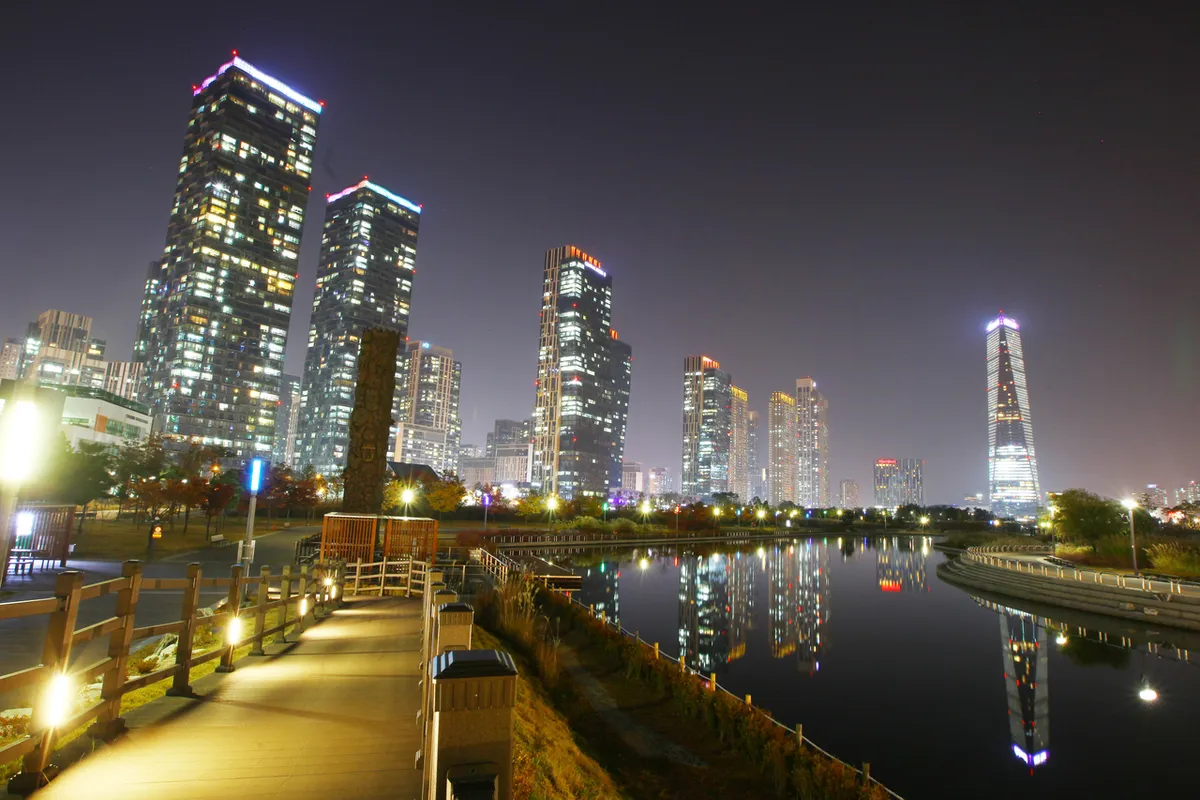
Photo: Korea Tourism Organization / Lee Beom-su (이범수), November 2015.
Lighting and the surrounding city buildings also form part of the evening waterfront setting. There is no single verified switch-on time to plan around, and an illuminated scene in a photograph is not a guarantee that every feature will be lit on a future visit.
Step-free entrance access and accessible toilets are documented for the park. The underground car park also has an elevator to the outside. These provisions do not establish that every path, deck or building interior is step-free, or that every lift is operating on the day; confirm any specific access requirement before travelling.
Pets are permitted with a leash and waste bags. For a November visit, do not plan around shade tents: the park's seasonal allowance applies from April through October. Seasonal water-play installations are separate from the main channel, and their closure does not mean the seawater landscape itself is closed.
The western footbath and ground-fountain operations ended on September 23, 2026. They are not included as winter experiences in this guide. Follow current on-site notices for maintenance rather than assuming all paths or facilities are available.
Browse hotels in Songdo if the park is part of a wider Incheon visit. Accommodation access and services are separate from the public waterfront spaces covered here.
Frequently Asked Questions
Is Songdo Central Park free to enter?
General park admission is free. Parking, independently operated services and cultural programs have separate conditions. Free park entry does not grant access to every nearby building.
Which subway station and exit should visitors use?
Use Central Park Station on Incheon Subway Line 1, Exit 3. That exit is listed for the park, Tri-Bowl and Songdo Hanok Village. A street-level elevator is available at Exit 3.
Is the water in the park seawater?
Yes. Water comes from the West Sea, passes through a three-stage filtration system and circulates through the park before returning to the sea. The channel is managed, not a natural tidal creek.
Can visitors enter Tri-Bowl at any time?
No unrestricted indoor access should be assumed. Exhibition entry depends on the dated program, and the exhibition scheduled through December 13, 2026, closes on Mondays. Exterior viewing and indoor admission are separate matters.
Is the park accessible for wheelchair users?
Step-free entrance access, accessible toilets and an elevator from underground parking are documented. Exit 3 at Central Park Station also has a street-level elevator. These features are not a guarantee covering every route or building.
Plan your Songdo visit
Explore Songdo hotels for accommodation planning, or browse things to do in Incheon to complement the public-landscape visit.
Songdo Central Park is a ground-level view of a planned city: water, gardens, artwork and contrasting buildings share the same setting. Base the visit on those public spaces, and check any separate venue or seasonal facility before adding it to your plans.
Sources & References
Park design, named gardens, seawater circulation, rules and seasonal notices: Incheon Facilities Corporation. Supporting visitor and accessibility information: Incheon Tourism Organization and Korea Tourism Organization. Transit: Incheon Transit Corporation. Tri-Bowl architecture and exhibition information: Incheon Foundation for Arts and Culture and Tri-Bowl.
Park facilities and gardens · Seawater circulation and seasonal rules · Visitor information · Grounds access and accessibility · Central Park Station.
Tri-Bowl architecture and facilities · October–December 2026 exhibition · Park notices.
Hero photo: Korea Tourism Organization / Kim Ji-ho (김지호), August 2017. Photos: Korea Tourism Organization, KOGL Type 1, with individual photographer and capture-date credits. Archival images do not establish present foliage, illumination, access or program availability.
Last verified: November 9, 2026. Facility hours, exhibitions and access conditions may change. Confirm current notices before visiting.