
The Korea Visa Portal classifies short visits by nationality, purpose of entry, and intended length of stay through its official Visa Navigator (Source: Ministry of Justice, Korea Visa Portal). This Korea tourist visa guide explains how to identify the correct route, find the responsible Korean diplomatic mission, prepare the official application file, pay the applicable fee, and check the result without treating one country’s checklist as universal.
1. The Visa Requirement Problem
There is no single document list that applies to every tourist. Korea’s official system asks for the traveler’s nationality or region, purpose of entry, and expected stay before presenting a possible visa category. For ordinary tourism, the relevant result is generally within the short-term visit group, but the precise category and eligibility decision must come from the Visa Navigator and the diplomatic mission responsible for the applicant.
This matters because visa rules and filing procedures can differ by nationality, place of residence, diplomatic mission, and application center. The Korea Visa Portal states that its document list represents minimum requirements. A Korean embassy or consulate may request additional material, exempt an item, or publish a local checklist that differs from the general portal guidance.
The diplomatic mission’s current instructions therefore control the local submission. An applicant should not copy a checklist from another country, rely on a travel agency’s summary as the final authority, or assume that a previous Korean visa application will use the same documents and procedure.
A visa is also different from the other documents travelers may encounter. K-ETA is an electronic travel authorization for eligible visa-free travelers. The e-Arrival Card records arrival information for immigration processing. A customs declaration concerns goods, currency, and duty rules. None of those documents replaces a visa when a visa is required.
2. The Official Visa Application Route
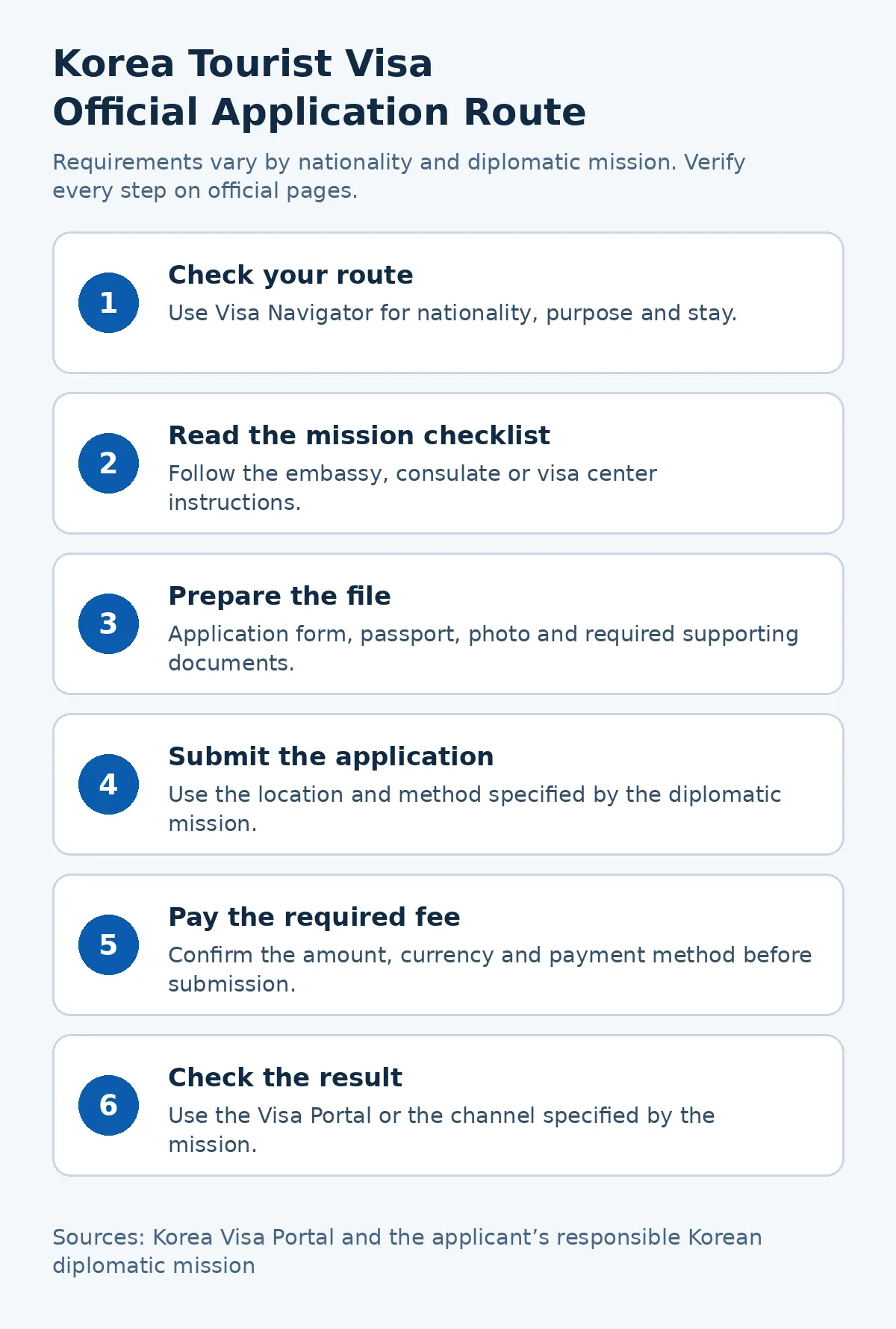
Start with Visa Navigator
Open the Korea Visa Portal Visa Navigator. Select the passport holder’s country or region, choose “Short Term Visit” as the purpose when appropriate, and select the intended length of stay. The tool separates stays of 90 days or less from longer stays and displays the relevant official category information.
Do not select a category solely because its name appears close to “tourism.” Business visits, group tourism, medical visits, family visits, paid activities, study, and employment can follow different rules. The stated purpose must match the traveler’s actual activity in Korea.
Important Warning: This guide does not determine whether a particular passport holder needs a visa. Use Visa Navigator and the responsible Korean embassy or consulate for that decision. Visa-waiver and K-ETA eligibility can change independently of tourist-visa procedures.
Find the responsible diplomatic mission
The portal’s Find a Diplomatic Mission directory lists Korean embassies and consulates by country. The general application page states that an overseas visa application is filed with the Korean embassy or consulate in the applicant’s country or area of residence.
After locating the mission, open its official website and find the visa section. Confirm whether applications are accepted directly, through a designated Korea Visa Application Center, through an authorized agency, or by another procedure stated by that mission. Also confirm whether an appointment is required. These arrangements are local and should not be inferred from another mission’s website.
Record the mission’s contact details, submission location, accepted payment method, and document-order instructions before preparing the file. If the portal’s general information and the mission’s checklist differ, the Korea Visa Portal directs applicants to follow the respective diplomatic mission’s requirements.

3. Step-by-Step Korea Tourist Visa Guide
Step 1: Download or complete the official form
The Korea Visa Portal identifies Visa Application Form No. 17 for applications through Korean diplomatic missions. The portal also provides an electronic form through its application menu. Use the format specified by the responsible mission, because a mission or visa center may publish instructions about signatures, printing, page order, or online pre-submission.
Enter names and passport details exactly as they appear in the passport. Check the intended purpose, address, contact information, travel dates, and sponsor or inviter fields against the mission’s instructions. Do not leave a required answer to be interpreted by the reviewing officer; use the mission’s guidance when a field does not apply.
Step 2: Prepare the standard items
For applications submitted through a Korean diplomatic mission, the Visa Portal lists the application form, passport, a natural-color photograph measuring 3.5 cm by 4.5 cm, the visa fee, and documents required for the corresponding status of stay. These are the central items, not a complete universal tourist checklist.
The supporting evidence must come from the current mission-specific notice. A mission may ask for documents connected to residence, travel purpose, itinerary, accommodation, finance, employment, invitation, family relationship, or return arrangements, but applicants should submit only what the responsible mission actually requires. Requirements taken from another embassy page may be incomplete or inappropriate.
Check whether originals, photocopies, certified copies, translations, or recently issued documents are required. Also check passport-validity and blank-page rules on the local mission page. This guide does not assign a universal validity period because the responsible mission must confirm the applicable standard.

Step 3: Confirm the submission channel
The Korea Visa Portal describes several visa routes, but ordinary individual tourism applications are not automatically eligible for every online route. The portal’s e-Visa page lists limited eligible statuses and applicant groups. Do not assume that seeing an e-Visa menu means a standard tourist application can be completed entirely online.
Follow the mission’s stated route. Depending on the country, this may involve an embassy, consulate, designated visa center, or authorized agency. Use only links reached from the Korea Visa Portal, the Ministry of Foreign Affairs mission directory, or the mission’s official government website. A commercial website should not be treated as a Korean government portal merely because it appears in search results.
Step 4: Submit the file and retain the receipt
Submit the form and supporting documents in the order requested. Keep the application or receipt number, the exact passport spelling used in the application, the submission date, and any tracking instructions. These details may be required to check the result or contact the mission.
Do not book a non-changeable journey on the assumption that an application will be approved by a particular date. The Korea Visa Portal does not publish one worldwide processing time for tourist applications. Review periods, appointment availability, requests for additional documents, and passport-return arrangements are handled by the responsible mission or application center.

Step 5: Pay the applicable visa fee
The Korea Visa Portal publishes standard visa fees in U.S. dollars: USD 40 for a single-entry visa permitting a stay of 90 days or less, USD 60 for a single-entry visa permitting a stay of 91 days or longer, USD 70 for a double-entry visa, and USD 90 for a multiple-entry visa. These are standard figures, not a guarantee of the amount collected in every country.
The portal states that fees may differ because of reciprocity, international practice, national agreements, or Ministry of Justice rules. Some nationalities may receive adjusted or exempted fees. A diplomatic mission may also specify the local currency and accepted payment method. Confirm the final amount directly with the mission before payment.
The official portal also states that the application fee covers review and evaluation and is not refundable when an application is denied. Online payments through the Visa Portal may carry credit-card or electronic-payment surcharges.
Money Tip: Do not send payment to a personal account or an unverified intermediary. Match the payment recipient, currency, and method to the mission or designated visa center’s official notice.
Step 6: Check the application result
Use “Check Application Status” on the Korea Visa Portal, or follow the tracking channel specified by the mission or visa center. Enter applicant information exactly as it was submitted. A local receipt or tracking number may be necessary.
When a result is available, verify the name, passport number, visa category, number of entries, validity information, and permitted stay shown in the official record. If any item appears incorrect, contact the issuing mission before travel rather than interpreting the record independently.

4. Pro Tips and Important Warnings
Use the newest mission notice
A diplomatic mission may publish several visa notices over time. Check the publication or update date and confirm that an older attachment has not been replaced. Save a copy of the checklist used for the application so that each submitted item can be traced to the applicable instructions.
Keep names and numbers consistent
Use the passport’s machine-readable identity details throughout the form, appointment, payment, and status search. Differences in spacing, name order, omitted middle names, or passport numbers can cause tracking problems. If a passport is renewed during the process, ask the issuing mission how to proceed.
Do not confuse validity with permitted stay
The period during which a visa may be used, the number of permitted entries, and the period of stay allowed after entry are separate fields. Read the issued record rather than assuming that all dates describe the same permission.
Respond through official channels
If the mission requests another document or an interview, use the contact method stated in the official notice or application record. Do not send passport scans, financial documents, or personal data to an address that cannot be verified on an official government or designated-center page.
Immigration Help: The Immigration Contact Center is available at 1345 in Korea. From overseas, use +82-2-1345. Mission-specific filing questions should still go to the responsible embassy, consulate, or visa center.
Traveler Support: Government service information is available through 110. Tourist interpretation is available through 1330, and BBB Korea provides interpretation at 1588-5644. For an emergency in Korea, call 112 for police or 119 for fire and ambulance services.
5. Frequently Asked Questions
How do I know whether I need a Korean tourist visa?
Use the Korea Visa Portal’s Visa Navigator with your passport country or region, purpose of entry, and intended stay. Then confirm the result with the Korean diplomatic mission responsible for your place of residence. Do not assume that another nationality’s visa-free or K-ETA rule applies to you.
Is a Korean tourist visa the same as K-ETA?
No. A visa and K-ETA are different authorizations for different eligible groups. Travelers who require a visa cannot replace it with K-ETA, while visa-free travelers should verify current K-ETA rules on the official K-ETA portal.
What documents are required for a Korean tourist visa?
The Visa Portal’s general mission-application list includes the official application form, passport, a 3.5 cm by 4.5 cm natural-color photograph, the fee, and status-specific documents. The responsible mission’s current checklist determines the supporting evidence and may add or exempt items.
How long does a Korean tourist visa take?
There is no single worldwide processing period published for every tourist application. Appointment availability, review time, additional-document requests, and passport return differ by mission and application center. Use the processing guidance published by the office handling your application.
Can I apply for a Korean tourist visa entirely online?
Not necessarily. The Visa Portal limits e-Visa routes to specified statuses and applicant groups. Follow the submission method published by your responsible Korean embassy, consulate, or designated visa center.
Sources and References
Official Government Sources:
- Korea Visa Portal — Visa Navigator, application procedures, forms, fees, mission directory, and application-status services
- Korea Visa Portal Visa Navigator
- Korean Diplomatic Mission Directory
- Hi Korea — immigration and stay information
- Official K-ETA Portal — separate authorization for eligible visa-free travelers
- Official Korea e-Arrival Card — separate arrival-information service
Image Credits: Passport stamps: Kit (formerly ConvertKit) / Unsplash. Open passport: Global Residence Index / Unsplash. Application documents: Scott Graham / Unsplash. Laptop application: Corinne Kutz / Unsplash. Online payment: rupixen / Unsplash. Passport travel concept: mana5280 / Unsplash.
Last verified: September 16, 2026.
Policy notice: Visa eligibility, document requirements, fees, appointment systems, and submission routes can change. Verify every application against the Korea Visa Portal and the responsible Korean diplomatic mission before filing.
This Korea tourist visa guide provides a verified application workflow, but the issuing authority’s current instructions remain controlling for each applicant.