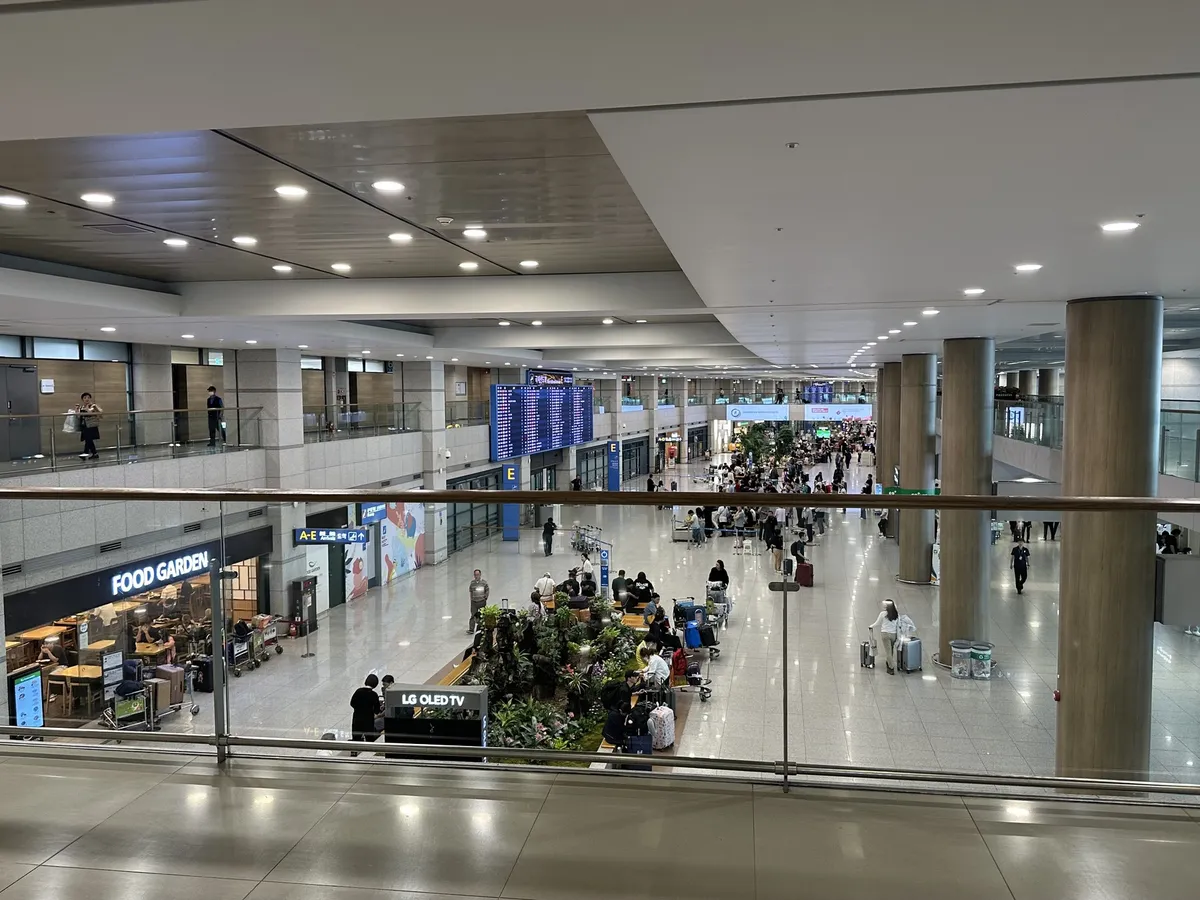
Incheon International Airport arrivals pass through immigration, baggage collection and customs before reaching the public arrival hall.
This Incheon airport arrival guide explains the terminal and Concourse routes, checked-baggage collection and meeting points, using the airport’s official arrival instructions. It covers entering Korea, not remaining airside for a connecting flight.
1. Incheon Airport Arrival Guide: Terminal or Concourse?
Start with the terminal shown on your flight information, rather than an airline list remembered from an earlier trip. Incheon Airport warns that codeshares and airline circumstances can change the actual terminal; it directs passengers to confirm through their e-ticket or the airport flight search.
Give the person collecting you the arriving flight number and confirmed terminal, not just the airline name. The airport’s arrival overview explains this distinction.

If your aircraft arrives directly at a passenger terminal, the official route begins through the boarding gate on the second floor. Follow the arrival route toward immigration. Do not head for the public meeting area yet: baggage claim and the inspections still come before the public arrival hall.
Concourse arrivals
A Concourse arrival adds a step. The airport instructs passengers arriving there to enter through the second-floor gate and take the shuttle train to the passenger terminal.
Its arrival page states that this shuttle operates around the clock. Follow the terminal-bound arrival signs rather than treating the Concourse as a separate public pickup terminal. This is the airport’s internal arrival movement, not the city-bound AREX journey covered later.
Quarantine instructions along the route
The arrival overview separates information and declarations from immigration. Passenger quarantine can also involve instructions along the arrival route. Follow the quarantine staff’s directions when they apply; the passenger quarantine page directs travelers to current Korea Disease Control and Prevention Agency notices for region-dependent requirements. This guide does not assume that every traveler needs the same health questionnaire.
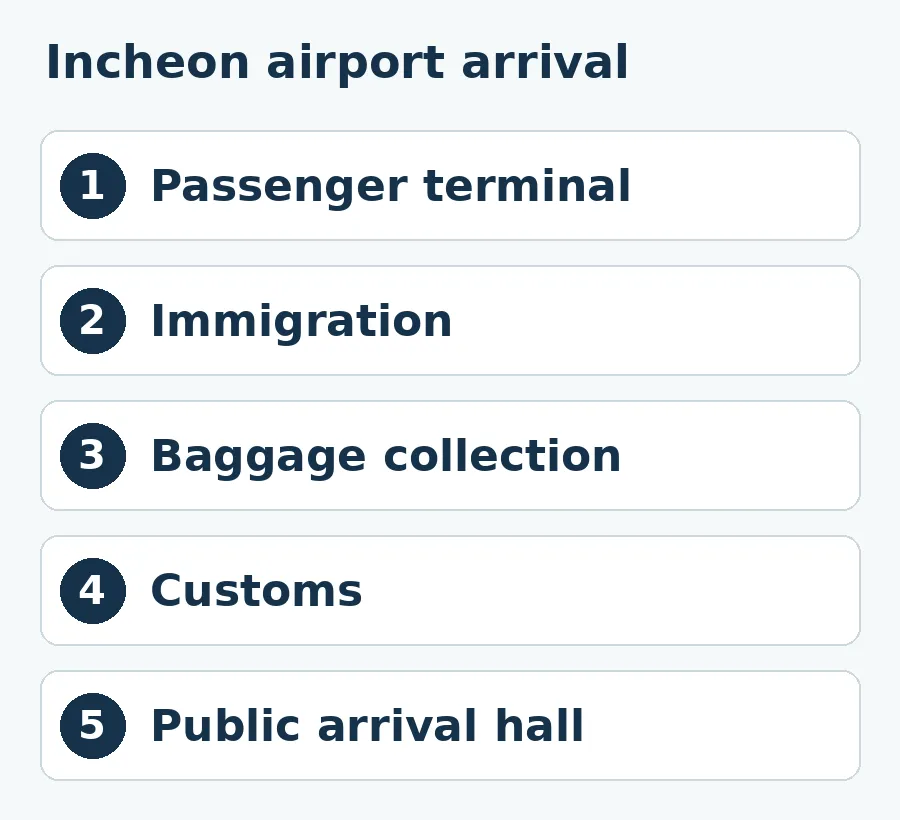
Simplified international-arrival sequence based on Incheon Airport guidance; this is not an airport map. Additional checks may apply.
2. Complete Immigration Before Looking for Your Bags
At staffed immigration, use the queue marked for foreign nationals unless airport staff direct you elsewhere. The airport describes separate inspection lines for Korean citizens and foreign nationals.
Present your passport and complete the arrival declaration if required for your circumstances. Cooperate with the officer’s face check and questions; these are part of the official manned immigration procedure, not an optional airport service.
Arrival-card requirements are not identical for every foreign traveler. Keep the distinction between a declaration and entry authorization clear: the Ministry of Justice describes the e-Arrival Card as a separate system from K-ETA.
Its current declaration guide says that someone who has submitted an e-Arrival Card does not also need to complete a paper arrival card. It also says you are not required to bring the electronic card to inspection, although knowing its issue number can help.
For document-specific requirements, use TripKorea’s South Korea Arrival Card Guide and the official portal rather than starting a second declaration simply because another passenger is filling out a form.
This article does not repeat the application fields, filing window, or exemptions. If your travel or stay information has changed, the ministry’s guide allows checking and editing before immigration inspection.

Illustrative online preparation, not a view of the government portal.
Biometrics and automated gates
For ordinary foreign visitors aged 17 or older, the airport’s staffed-inspection instructions include fingerprints and a facial image. Follow the officer’s directions at the counter. Do not infer from biometric collection that you can use an automated arrival gate on a future trip: the airport’s Smart Entry Service guidance distinguishes short-term visitors’ departure use from other eligible categories.
Use a staffed arrival lane unless you have confirmed that you qualify for an automated one. The Korea Immigration Service SES page lists specific foreign-national categories; it does not promise automated arrival clearance to every tourist with a biometric passport.
For a visa or immigration question, the official Immigration Contact Center is 1345. Its published counseling hours are weekdays, 09:00–22:00, with Korean, English, and Chinese available after 18:00.
3. Find the Correct Baggage Belt and Resolve Problems
After immigration, check the display for your baggage carousel number before going down to the first floor. The airport’s baggage claim instructions specifically place the display check before the elevator or escalator journey. Match the arriving flight to its assigned carousel; a nearby belt or the belt used on a previous visit is not your assignment.
At the designated carousel, collect your bags and check that they are yours. The airport explicitly warns against baggage mix-ups. A matching color or suitcase model is not enough to identify a bag; use its own identifying details before leaving the belt. Keep your baggage claim information available while resolving any uncertainty with the airline.
Oversized baggage
Large baggage follows a separate collection route. Incheon’s instructions tell passengers to collect it from the oversized baggage carousel. Terminal 1 has its own marked oversized collection points; the Terminal 2 map shows collection points on the A and B sides.
Use the oversized signs and your terminal’s map instead of assuming that a stroller or another large checked item will emerge on the ordinary belt.
Missing or damaged checked bags
If checked baggage does not arrive or is damaged, use the lost-baggage counter and contact the airline responsible for the flight. For damage, the airport specifically instructs you to report it immediately at the Lost Baggage Information Counter behind the carousel; an airline representative then checks the damage and handles the report.
The airport’s lost or damaged baggage page maps these counters on the first floor in both terminals. Its responsibility table routes in-flight lost items and baggage to airlines, rather than treating them as ordinary property lost in the terminal.
That distinction determines whom to approach. A bag missing from the flight is an airline-baggage issue; an item left in a passenger terminal or another airport common area is a different lost-property case.
Explain which happened when asking for help. A practical precaution is to resolve the airline reporting route in the baggage area before continuing to customs, rather than leaving with only a general airport lost-property contact.
For foreign airlines and low-cost carriers, the airport’s responsibility table lists 1577-2600. The airport also publishes that number as its general information contact.
Use it for routing assistance if you cannot identify the relevant counter; do not assume that the airport itself will determine airline compensation, delivery arrangements, or a claim deadline. Those details are outside this guide.
Baggage equipment context — Terminal 1 outdoor trolleys, 2024
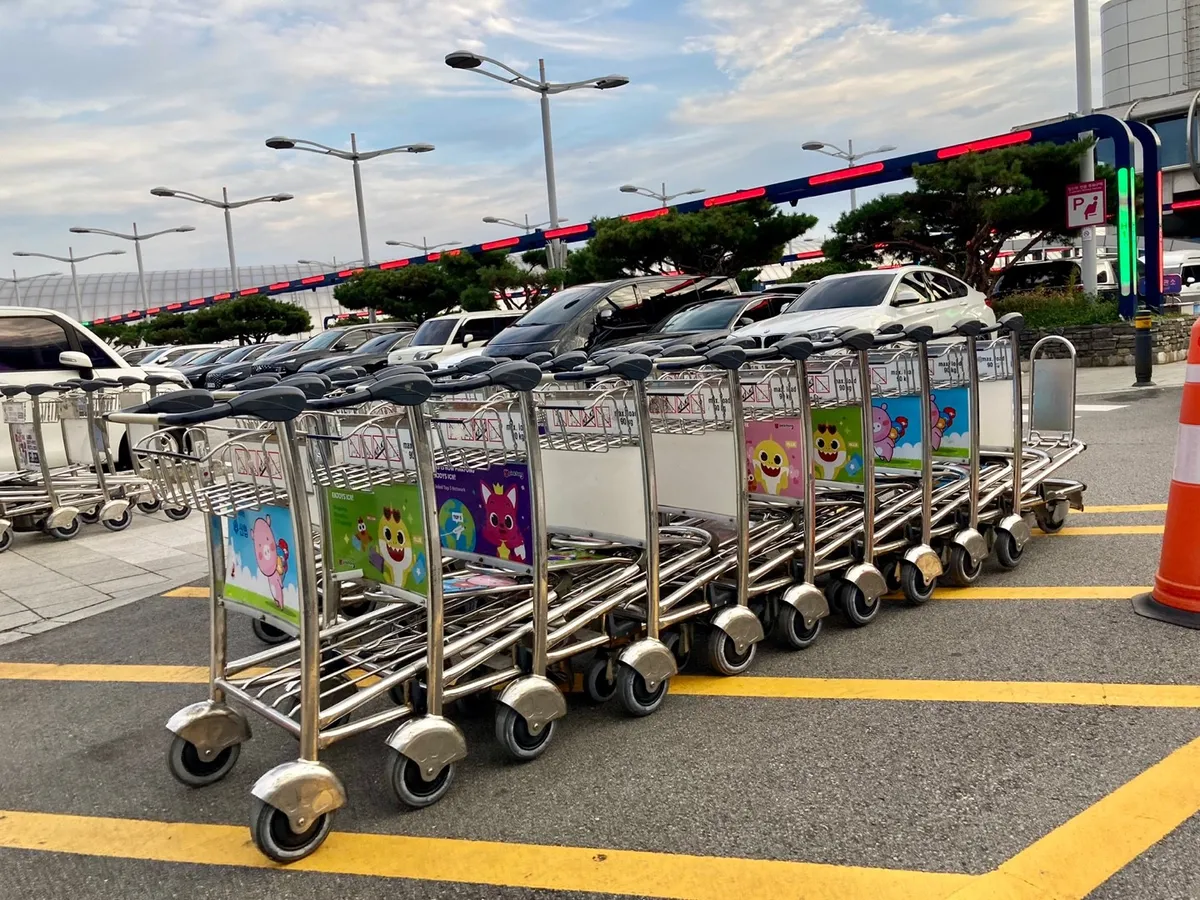
Baggage trolleys outside Incheon Airport Terminal 1, photographed in 2024; this is not a reclaim carousel.
4. Pass Customs and Agree on a Public Meeting Point
Collecting luggage does not finish the arrival process. Continue to customs before entering the public arrival hall. The airport customs guide directs travelers with items to declare to complete a declaration and use the “Goods to Declare” lane. Its inspection diagram places baggage collection before this customs stage.
Customs concerns what you are bringing into Korea, not whether you completed your immigration arrival card. For allowances, reportable currency, restricted goods, and detailed declaration instructions, use TripKorea’s Korea Customs Declaration Guide and the official customs guidance.
If you cannot determine whether an item needs declaration, ask the customs officer before choosing your exit route. This arrival walkthrough does not reproduce monetary limits or interpret individual import cases.
Goods requiring quarantine inspection
Quarantine can require a separate officer’s attention. The airport’s animal and plant quarantine page instructs travelers carrying covered animal, livestock, or plant products to declare them and undergo inspection.
Its seafood quarantine page separately covers live aquatic animals and specified refrigerated or frozen products. For applicable seafood, it includes verbal declaration to the aquatic animal quarantine officer. Do not treat an immigration declaration as completing these goods-related procedures.
Meeting in the public arrivals hall
After completing the arrival inspections, continue into the public first-floor arrival hall. The airport’s welcome information maps distinguish Terminal 1 arrival halls A–F and numbered entrances 1–14 from Terminal 2 arrival halls A–B and entrances 1–10. They also mark information desks in both terminals.
Use those labels to agree on a precise meeting point: terminal, first-floor public area, and an arrival-hall letter or numbered entrance. The airport says greeters can check the flight’s arrival time and designated exit on the large display in front of the arrival hall; it warns that passengers using another exit may miss their greeters.
Check that displayed exit when arranging the meeting. An arrival-hall letter and a numbered building entrance are different labels; specify which one you mean. This is a planning recommendation based on the official map, not a universal meeting spot assigned to every passenger.
Historical arrivals display — 2007
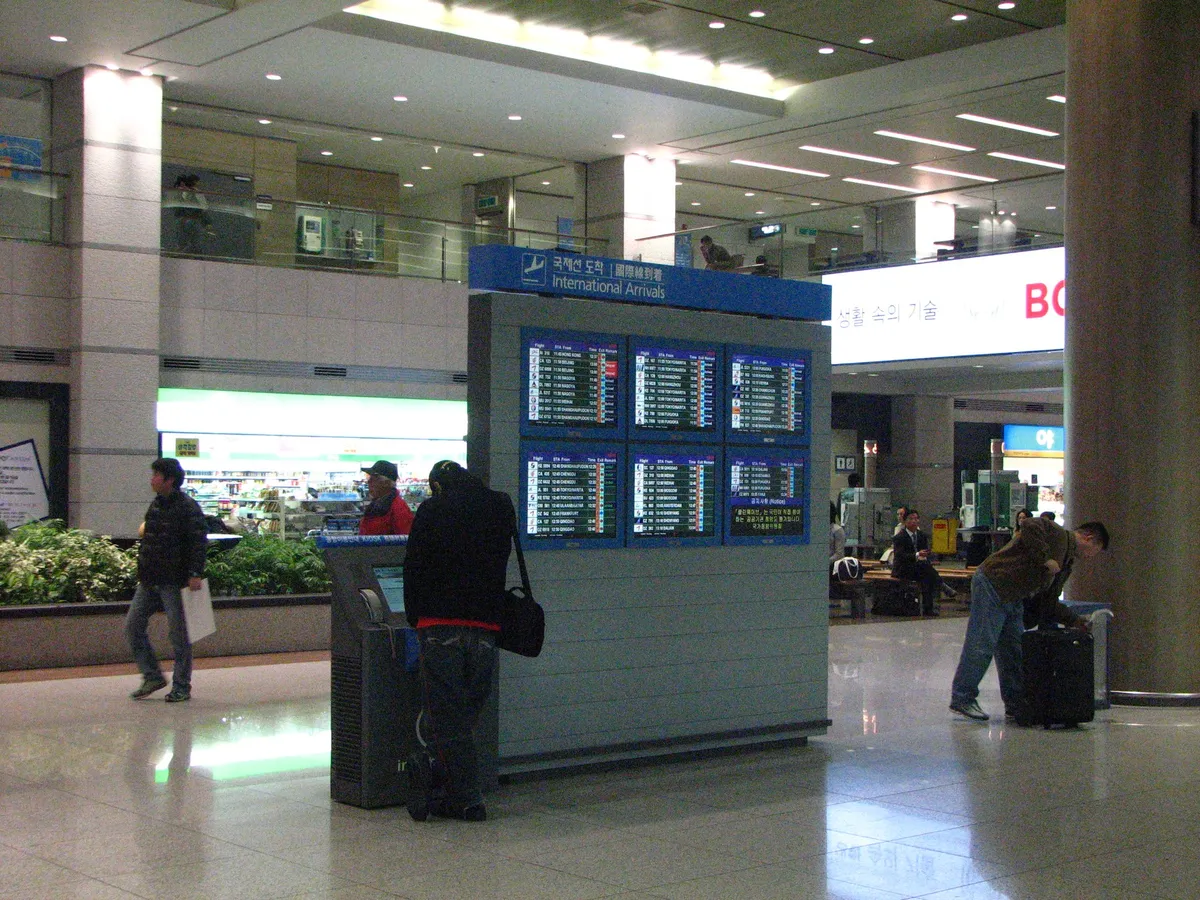
Historical view of an Incheon Airport international-arrivals display in 2007. Use the current display and airport map for your meeting point.
If you cannot locate the person collecting you, ask for directions at one of the information desks marked on the airport’s public-area map, then send your confirmed location.
📞 Arrival Support & Emergency Numbers
For airport directions, call 1577-2600; immigration counseling is 1345. For tourism information and interpretation, use 1330. BBB Korea offers telephone interpretation at 1588-5644, available 24 hours.
For an emergency in Korea, call 119 for fire or medical assistance, or 112 for police. Government civil-service inquiries go to 110. These are domestic contact numbers, not substitutes for the airline’s baggage-reporting counter.
5. Frequently Asked Questions
Do Concourse arrivals go straight to a public pickup hall?
No. The airport directs Concourse arrivals through the second-floor gate and onto the shuttle train to the passenger terminal. Complete immigration, baggage collection, and the relevant inspections before meeting someone in the public arrival hall.
Can every foreign tourist use an automated arrival gate?
No universal arrival entitlement is stated in the official SES guidance. The airport distinguishes short-term visitors’ automated departure use from other eligible categories. Use the staffed foreign-national arrival queue unless immigration staff confirm that your status permits another route.
Where do I collect oversized baggage?
Use the oversized baggage collection point rather than assuming the ordinary carousel will deliver it. The airport maps Terminal 1 collection points and Terminal 2 collection points on the A and B sides. Follow the signs for your actual terminal.
Who handles a checked bag missing from my flight?
The airport routes in-flight lost items and baggage to airlines. Approach the mapped lost-baggage counter and identify your flight. Airport common-area lost property is a separate responsibility, so make clear that the item was checked onto the aircraft.
Where should someone meet me after arrival?
Agree on a specific first-floor public location using the airport’s welcome map: terminal plus an arrival-hall letter or numbered entrance. Information desks are marked in both terminals. Finish the inspection sequence first; the Incheon Airport Arrival Guide ends where your public-hall meeting and onward journey begin.
Onward Travel
The Incheon airport arrival sequence ends in the public hall. For the journey from there, use the Korea Airport Transfer Guide or the AREX Airport Train Guide.
Onward-travel context — Transportation Center, 2016
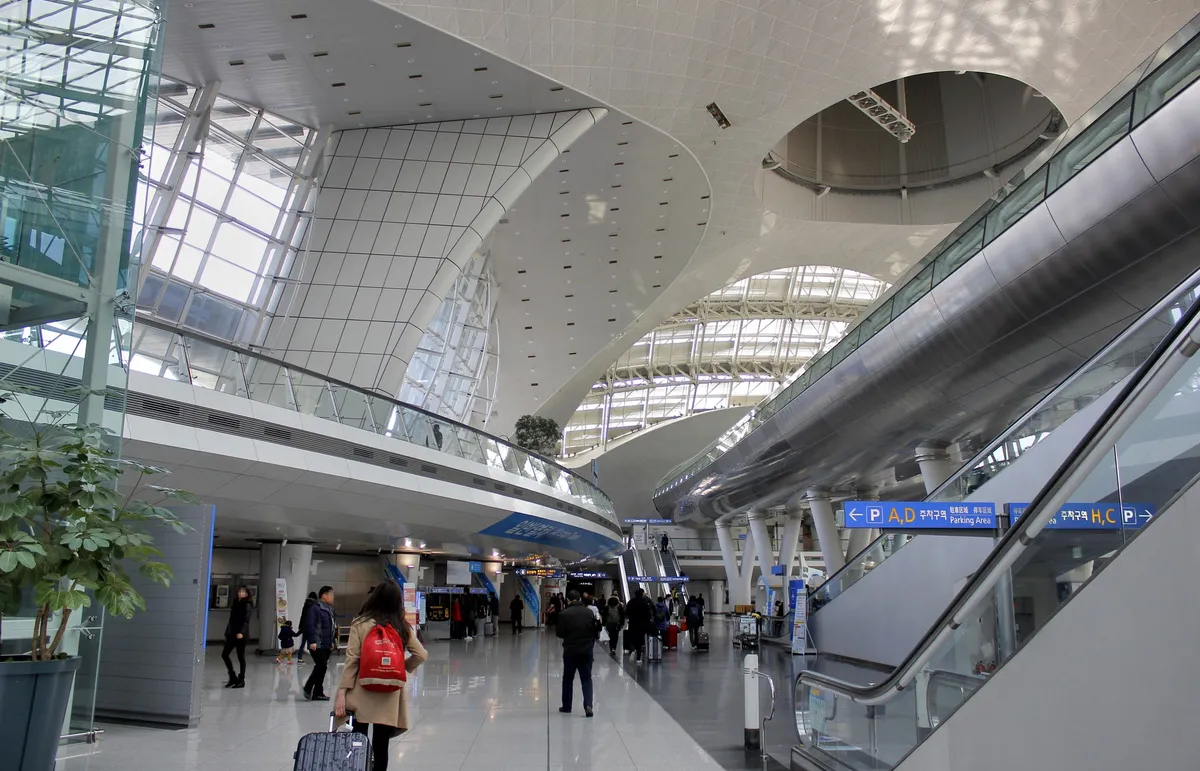
Incheon Airport Transportation Center in 2016, shown as onward-travel context rather than the immigration or Concourse arrival route.
Sources & References
Incheon Airport: Arrival procedures and terminal confirmation
Incheon Airport: Passenger quarantine, animal and plant quarantine, and seafood quarantine
Incheon Airport: Welcome information and public arrival-hall maps
Ministry of Justice: Automated Immigration Clearance Service
Korea Tourism Organization: Emergency situations and travel hotline
Last verified: 2026-10-08 KST (UTC+09:00). Terminal assignments and entry procedures can change. Follow current airport signage and instructions from the relevant airline, immigration, customs, and quarantine officers.
Image Credits
Hero: ノボホショコロトソ / Wikimedia Commons (CC BY 4.0).
Transportation Center, 2016: Minseong Kim / Wikimedia Commons (CC BY-SA 4.0).
Terminal 1 outdoor trolleys, 2024: Narubaru7 / Wikimedia Commons (CC BY 4.0).
Arrivals display, 2007: Rintojiang / Wikimedia Commons (Public domain).
Document preparation: Luke Southern / Unsplash (Unsplash License).
Online preparation: Vitaly Gariev / Unsplash (Unsplash License).
Original arrival-sequence diagram: TripKorea / Airport source guidance (Original explanatory graphic).